
7 Best Aluminum Profiles for Solar Panel Frames
Choosing the right Aluminum Profile For Solar Panel Frame is a practical decision that affects panel support, installation, and long-term durability. A frame must hold the module securely while facing wind, rain, temperature changes, and repeated handling. Small details matter. Profile shape, wall thickness, alloy, and surface finish can all influence how well a frame performs in a particular system.
This guide introduces seven common aluminum profile options for solar panel frames, from compact sections for lightweight modules to stronger designs for larger panels. Each option has different trade-offs in stiffness, weight, fabrication, and mounting convenience. A deeper channel may improve rigidity, for example, but it can also add material and affect assembly. The right choice depends on panel dimensions, support spacing, mounting hardware, exposure conditions, and the manufacturer’s specifications. There is no universal winner.
In practice, compare profile drawings and verified material data rather than relying on appearance alone. Check dimensions, alloy and temper information, coating details, and compatibility with the intended clamps. If a supplier cannot provide clear specifications, ask before committing. That step is easy to skip. It should not be. This overview offers a starting point, not a substitute for engineering review or product-specific installation guidance. Some designs may look efficient on paper yet prove awkward during assembly; that possibility deserves honest attention. Use the seven profiles as a shortlist, then confirm that the selected frame suits the actual module and mounting system.
What Aluminum Profiles Do in Solar Panel Frames
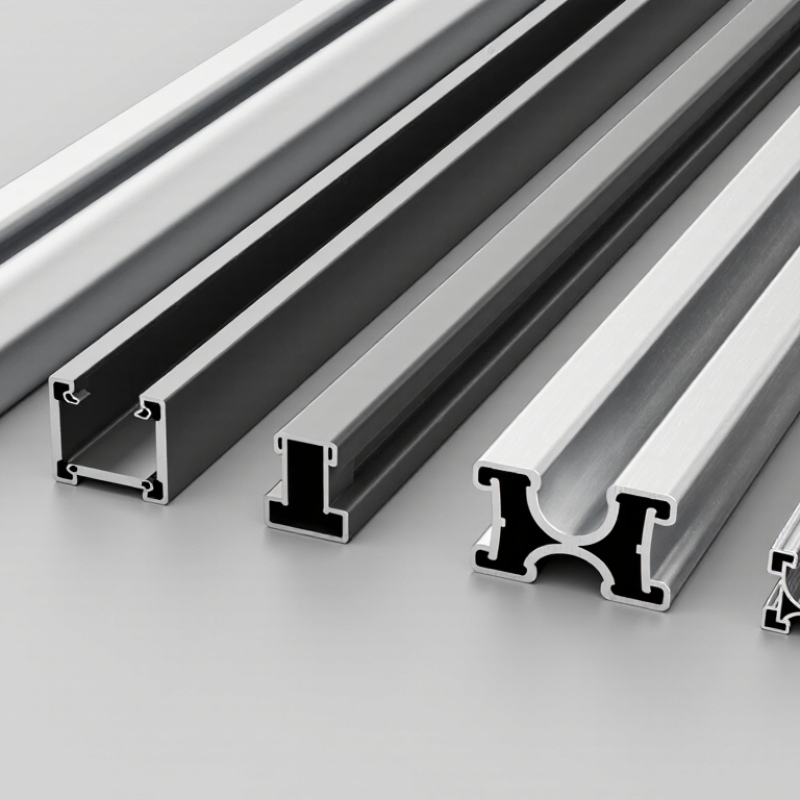
Aluminum profiles form the rigid perimeter around a solar module. They help hold the glass, cells, and backsheet together, while protecting fragile laminate edges during transport and installation. Their channels also provide mounting surfaces for clamps and rails. Small details matter. A poorly placed clamp can concentrate force near the glass edge, so profile geometry and approved clamping zones must work together.
The need for reliable frame design is growing with deployment. IRENA’s Renewable Capacity Statistics 2025 reports that global solar capacity reached about 1,865 GW by the end of 2024, after roughly 452 GW was added that year. This figure describes solar capacity, not frame performance, but it shows the scale at which consistent component design matters. Extruded profiles are often selected for their balance of low weight, stiffness, and corrosion resistance. Alloy temper, wall thickness, corner joints, and surface treatment still affect performance. A heavier profile is not automatically safer; support spacing and fastener placement matter too. Not by itself. Drainage paths should also let water escape rather than collect inside the frame. Designers should verify the module’s tested load limits and installation instructions, because one profile cannot suit every climate or mounting system. Even a sound design deserves a second check.
7 Best Aluminum Profiles for Solar Panel Frames — What Aluminum Profiles Do in Solar Panel Frames
The profile dimensions below are indicative design ranges, not universal specifications. Actual sections depend on the module, glass and laminate thickness, mounting system, loads, and applicable standards. Confirm dimensions and alloy temper with the profile supplier and module design.
| Aluminum profile type | Typical section dimensions (mm) | Common alloy and temper | What it does in a solar panel frame | Advantages | Design considerations |
|---|---|---|---|---|---|
| 1. Standard perimeter frame | Frame depth: about 30–40; visible face width: about 8–15 | Common extrusion choices include 6005-T5 and 6063-T5 | Encloses the module edges, supports the glass-and-laminate assembly, and provides a practical interface for mounting. | Widely adaptable to conventional framed modules; balances stiffness, weight, and material use. | Match the channel and retaining lips to the module stack thickness, sealant or gasket, and corner-joint method. |
| 2. Deep-section perimeter frame | Frame depth: about 40–50; visible face width: about 10–18 | Often specified in 6005-T5 or 6061-T6, depending on design requirements | Provides a deeper section for applications where added frame rigidity or a taller mounting interface is needed. | Greater section depth can improve bending stiffness without requiring a solid section. | More depth may add material and module thickness; structural performance still depends on geometry, alloy, joints, and support spacing. |
| 3. Low-profile perimeter frame | Frame depth: about 25–35; visible face width: about 8–15 | Commonly 6063-T5 or 6005-T5 | Frames modules where a lower edge profile or reduced overall frame depth is preferred. | Can reduce frame height and material compared with a deeper section. | Reduced section depth can limit stiffness; verify structural loads, handling requirements, and mounting compatibility. |
| 4. Wide-lip retaining profile | Frame depth: about 30–40; retaining lip or face width: about 12–20 | Common choices include 6063-T5 and 6005-T5 | Uses a broader retaining face to overlap and secure the module edge, subject to the module’s approved frame design. | Offers a larger contact area for edge retention and can accommodate some assembly designs with wider frame faces. | Keep the retaining geometry clear of the active cell area and ensure it does not create excessive stress on the glass edge. |
| 5. Drainage-channel profile | Frame depth: about 30–45; channel dimensions are design-specific | Commonly 6005-T5 or 6063-T5 | Incorporates a channel or openings intended to help manage water at the module perimeter. | Can provide a defined path for water to exit the frame area when correctly designed and installed. | Drainage details must avoid water traps and remain compatible with the module orientation, seals, and cleaning conditions. |
| 6. Reinforced-corner-compatible profile | Frame depth: about 30–45; internal joint features vary by corner design | Often 6005-T5 or 6063-T5 | Provides internal pockets, grooves, or shoulders designed to work with corner keys or other frame-joining methods. | Supports repeatable assembly and helps keep frame corners aligned. | Corner strength depends on the complete joint, including the key or fastener, fit, tolerances, and assembly process. |
| 7. Mounting-interface-integrated profile | Frame depth: about 30–50; mounting groove or slot is system-specific | Commonly 6005-T5 or 6063-T5 | Includes a groove, channel, or shaped surface intended to engage compatible clamps or mounting hardware. | Can simplify the interface between the module frame and a compatible mounting system. | Check clamp position, engagement, fastener loads, and installation instructions; a profile feature alone does not establish system compatibility. |