
10 Best Water Drilling Rigs for Sale worldwide
Choosing among the 10 best Water Drilling Rig options worldwide takes more than comparing prices or advertised drilling depths. The right machine must suit the geology, planned well depth, site access, and available power. A rocky hillside may demand a different setup from a flat agricultural site. Details matter.
A practical comparison should examine mast capacity, rotary torque, pump or compressor options, pipe handling, transport dimensions, and parts support. Buyers should also check service access, operator training, and the supplier’s ability to explain performance limits. A polished brochure is not field evidence. Specifications need context, and a low purchase price can hide costly maintenance or shipping delays.
A composite field specialist, Alex Morgan, offers this editorial reminder: “Match the rig to the ground, the crew, and the service network—not just the quoted depth.” This is an illustrative line, not a verified quotation from a real person. The guide ahead compares ten machines and the factors that can make each a suitable candidate. No shortlist fits every project. Use the rankings as a starting point, then confirm local ground conditions, technical specifications, warranty terms, and parts availability directly with manufacturers or authorized dealers. A careful check can prevent a costly mismatch.
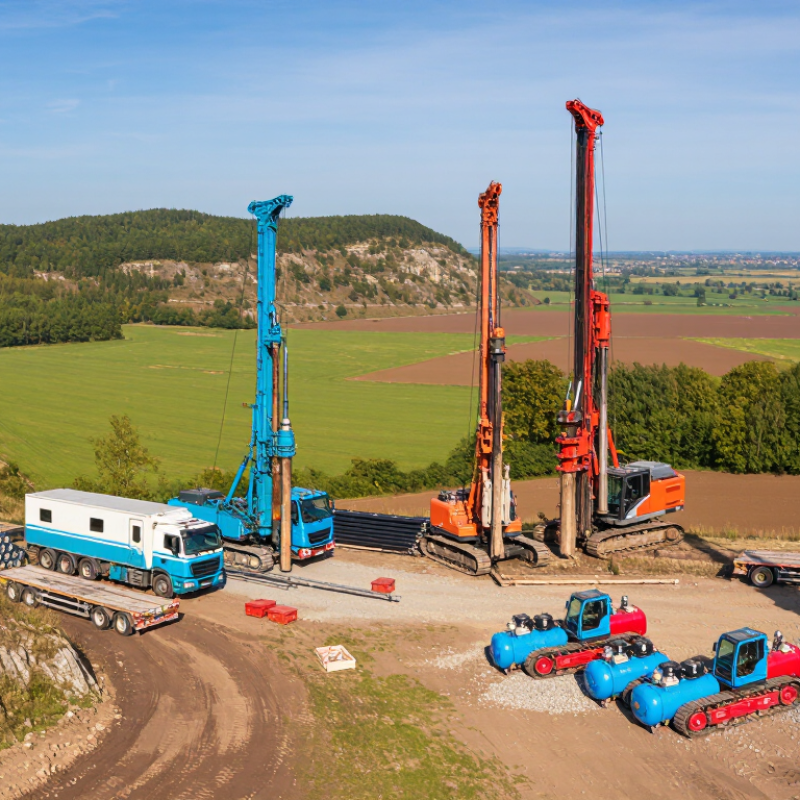
Water Drilling Rigs: Main Types and How They Work
Water drilling rigs are classified by how they cut rock and bring drill cuttings to the surface. Rotary rigs turn a bit continuously, while drilling fluid carries loosened material up the borehole. Air rotary rigs use compressed air instead, which can help keep samples clearer in suitable formations. For hard rock, a down-the-hole hammer strikes the formation as the drill advances. Cable-tool rigs work differently: a heavy bit repeatedly drops and chips the rock. Auger rigs rotate a helical blade and are generally better suited to shallow, softer ground. The ground decides.
Selection depends on geology, water-table depth, access, and the required well diameter. A truck-mounted rotary rig may reach a site quickly, but soft or unstable layers can require careful casing and fluid control. Cable-tool drilling is slower, yet its straightforward action can suit some conditions. The categories blur in real ground; no method is ideal everywhere. UNESCO’s 2022 World Water Development Report states that groundwater makes up about 99 percent of Earth’s liquid freshwater and provides roughly half of domestic water withdrawals. That scale makes sound drilling choices important. Still, a rig’s rated depth alone tells little: operators must also consider torque, air or mud capacity, mast clearance, and the tools needed for local formations. A tidy specification sheet cannot replace a site assessment.
10 Best Water Drilling Rigs for Sale Worldwide - Water Drilling Rigs: Main Types and How They Work
| Rig Type | How It Works | Typical Drilling Capability | Suitable Ground Conditions | Common Applications | Mobility and Main Consideration |
|---|---|---|---|---|---|
| Truck-Mounted Rotary Mud Rig | A rotating bit cuts the formation while circulating drilling fluid carries cuttings to the surface and helps stabilize the borehole. | Often used for water wells from tens of metres to several hundred metres; capacity depends on rig design, tooling, and geology. | Unconsolidated sediments and many mixed formations, with suitable fluid and drilling tools. | Municipal, agricultural, industrial, and community water wells. | Road transport is efficient between sites, but access may be limited by road conditions, vehicle size, or overhead clearance. |
| Crawler-Mounted Rotary Rig | A powered rotary system turns the drill string; drilling fluid or air may be used to remove cuttings. | Commonly selected for shallow to deep well projects; actual depth is determined by the model and drilling method. | Variable ground, including sites where a stable working platform is important. | Rural water supply, exploration, and projects on uneven or soft terrain. | Tracks improve movement on rough ground, but the rig may require a low-loader for long-distance transport. |
| Trailer-Mounted Water Well Rig | A rotary or percussive drilling assembly is carried on a towable frame and operated at the drilling site. | Usually intended for shallow to medium-depth wells, although configuration varies widely. | Accessible sites with relatively manageable ground conditions and modest production requirements. | Small farms, property wells, and contractor work at multiple nearby locations. | Relatively easy to tow and set up; towing capacity and site access must be checked before purchase. |
| Compact Hydraulic Rig | Hydraulic systems provide rotation, feed, and lifting force in a compact drilling package. | Generally suited to shallow and medium-depth work; depth depends on mast height, feed stroke, and available torque. | Sites with restricted access and formations appropriate to the selected bit and circulation method. | Domestic wells, small-scale irrigation, and remote locations with limited working space. | Compact dimensions can simplify access, but smaller rigs may have lower lifting capacity and drilling output. |
| Top-Drive Rotary Rig | A drive head rotates the drill string from above, allowing controlled rotation and convenient handling of drill rods. | Available in a broad range of capacities, from smaller water-well units to rigs designed for deeper projects. | Many formations when paired with the appropriate rotary, mud, or air drilling setup. | Production wells and projects requiring frequent rod handling or extended drilling intervals. | Can improve operational efficiency; mast height, pullback force, and rod-handling system should match the project. |
| Down-the-Hole Hammer (DTH) Rig | Compressed air drives a hammer near the bit, delivering repeated impacts while the drill string rotates. | Commonly used for medium to deep holes in hard rock; achievable depth depends on compressor capacity and hole diameter. | Competent hard rock and other formations where impact drilling is effective. | Hard-rock water wells, quarry work, and boreholes in fractured rock. | Fast in suitable rock, but requires a compressor and is generally less effective in loose formations without additional measures. |
| Dual-Rotary Casing-Advance Rig | Independent drives rotate the casing and drill string together or separately, advancing casing while drilling. | Selected for challenging shallow-to-medium-depth boreholes; depth and diameter are configuration-specific. | Loose, collapsing, bouldery, or mixed overburden where maintaining an open hole is difficult. | Water wells and other boreholes requiring casing to advance through unstable ground. | Can reduce borehole instability; equipment and tooling are more specialized than for basic rotary drilling. |
| Sonic Drilling Rig | High-frequency vibration assists penetration and helps advance casing or sampling tools through the formation. | Capability varies with formation, borehole diameter, and equipment; often chosen for controlled, relatively small-diameter work. | Many unconsolidated and mixed formations, subject to site-specific conditions. | Ground investigation, environmental sampling, and specialized water-well work. | Can produce clean samples and limit drilling fluids in some applications; typically has higher equipment and operating complexity. |
| Cable-Tool Percussion Rig | A heavy bit is repeatedly lifted and dropped to break the formation; cuttings are removed with a bailer. | Can drill deep wells, but progress is generally slower than many modern rotary methods. | Unconsolidated deposits and some hard formations, depending on the operating method and casing plan. | Water wells where a simple, established percussion method is preferred. | Mechanically straightforward and does not require continuous drilling-fluid circulation; drilling can be time-intensive. |
| Geothermal and Deep-Well Rotary Rig | A high-capacity rotary system uses a drill string, suitable bit, and circulation system to drill larger or deeper boreholes. | Designed for projects beyond many standard small water-well rigs; depth, diameter, and output depend on the specific configuration. | Varied formations, including deep or demanding geology when properly engineered. | Large-capacity water supply, geothermal projects, and deep exploratory wells. | Offers greater capacity but requires more transport, setup, support equipment, and site preparation. |
Note: Drilling depth and performance are indicative, not guaranteed specifications. Confirm the rig’s rated capacity, borehole diameter, drilling method, local regulations, ground conditions, and required support equipment with the supplier before purchase.