
China Best Evaporation Evaporators for Sale?

China’s industrial buyers are searching for reliable Evaporation Evaporators, not merely low prices. The right system must match feed composition, viscosity, heat sensitivity, capacity, and local operating conditions. A stainless-steel falling-film unit may suit dairy concentration, while a forced-circulation evaporator can handle crystallizing solutions more effectively.

The global industrial evaporators market reflects this demand. Grand View Research estimated the market at approximately USD 4.6 billion in 2023. Its report also projects steady growth through 2030, supported by food processing, chemicals, pharmaceuticals, and wastewater treatment. MarketsandMarkets has similarly identified energy efficiency and multiple-effect designs as important purchasing drivers. These figures are useful, but market estimates differ by product definition and research method. Buyers should examine the methodology.

Warren L. McCabe and his co-authors defined evaporation as “the concentration of a solution consisting of a nonvolatile solute and a volatile solvent.” That principle still guides equipment selection. In practical testing, engineers inspect steam consumption, heat-transfer performance, vacuum stability, cleaning access, and final-product quality. Small details matter. A poorly designed separator can increase entrainment, product loss, and maintenance time.

This guide evaluates China-based Evaporation Evaporators through technical capability, documented experience, material quality, customization, and after-sales support. Factory photographs are not enough. Verified test data matters more. Some supplier claims may look impressive, yet independent validation is often limited. That is an uncomfortable gap, and buyers should acknowledge it before signing a purchase contract.
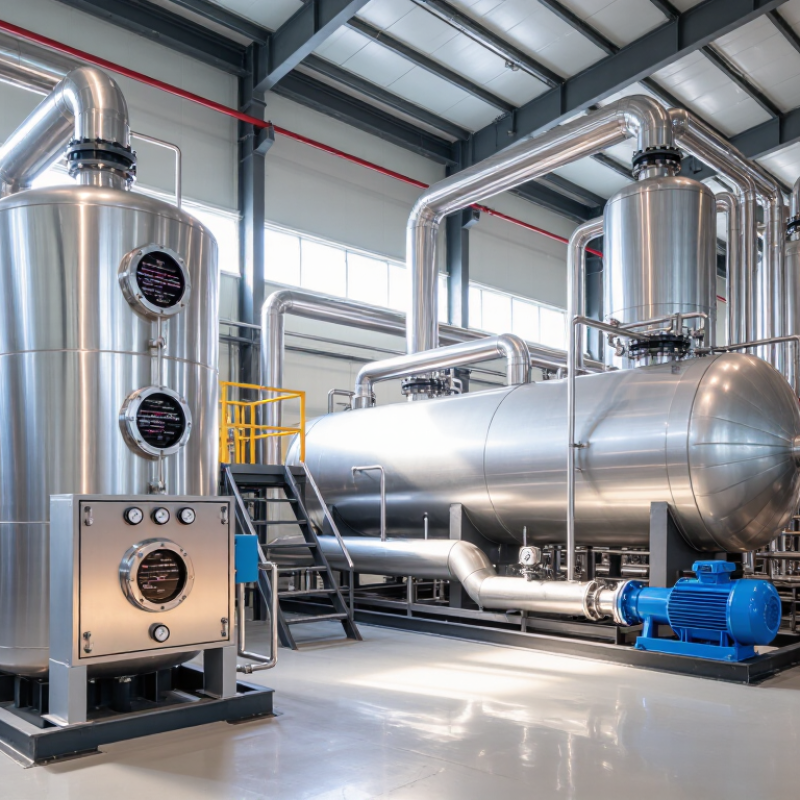
China Best Evaporation Evaporators for Sale?

Evaporation Fundamentals: 1–50 t/h Capacity, Mass Balance, and Boiling Point Rise

China Best Evaporation Evaporators for Sale?

Evaporation design begins with a clear capacity basis. Is 1–50 t/h the feed rate, vapor load, or concentrated product flow? That distinction changes the equipment size. A practical mass balance is F = P + V, where F is feed, P is product, and V is evaporated water. For a 10 t/h feed at 20% solids, producing 50% solids, the product flow is 4 t/h and water removal is 6 t/h. The numbers look simple. Real plants are not.

Heat demand depends on steam economy, boiling point rise, and heat losses. The U.S. Department of Energy reports that multiple-effect evaporation can reduce live-steam use substantially compared with single-effect operation. Typical preliminary estimates place steam consumption near 0.2–0.4 t per tonne of removed water for multi-effect systems, but feed conditions can shift this range. Treat it as a design guide, not a promise. The European Commission’s 2019 food, drink, and milk industry BAT reference document also emphasizes heat recovery and process integration.

Boiling point rise is easy to underestimate. Dissolved salts, sugars, and proteins increase liquor boiling temperature, reducing the effective temperature difference. Steam tables from the International Association for the Properties of Water and Steam support accurate vapor-property calculations. At higher concentration, viscosity may rise sharply, slowing circulation and increasing fouling risk. A clean spreadsheet can still lie. Pilot data, measured solids, and conservative heat-transfer coefficients deserve more trust than a perfect-looking quotation.

Evaporation Fundamentals: 1–50 t/h Capacity, Mass Balance, and Boiling Point Rise

This mass-balance chart uses a representative evaporation basis: 10 wt% soluble solids in the feed, 50 wt% solids in the concentrated product, and no solids loss. Evaporation capacity is defined as the water removal rate.

Under these assumptions, feed throughput equals 1.25 times the evaporation rate, while concentrated product equals 0.25 times the evaporation rate. Actual steam consumption and heat-transfer area depend on boiling point rise, temperature difference, fouling, vapor recompression, and the selected evaporator configuration.

Chinese Evaporator Types: Falling-Film, Forced-Circulation, and MVR Systems

China’s best evaporator depends on liquor behavior, steam cost, and operating stability. Falling-film evaporators suit clean, low-viscosity liquids with steady feed rates. Thin liquid films improve heat transfer and reduce residence time. They often fit dairy, food, and chemical concentration duties.

Forced-circulation evaporators handle scaling, crystals, and viscous fluids more reliably. A circulation pump keeps solids moving through the heater and separator. This design usually needs more electricity and maintenance.

MVR systems reuse vapor compression to reduce fresh steam demand. Engineering studies commonly report 80–95% lower steam use under suitable conditions.

The International Energy Agency’s Energy End-uses and Efficiency 2024 report identifies industry as consuming roughly 37% of global final energy. That makes thermal integration commercially important, not merely technical.

The United Nations Industrial Development Organization also emphasizes energy efficiency measurement at process level. Buyers should request heat-transfer area, evaporation capacity, compressor power, and fouling data. Ask for results using similar feed chemistry.

Small details matter. A falling-film unit may look efficient on paper, yet fail with unstable viscosity. MVR may reduce operating costs, but high electricity prices can weaken its advantage.

My practical preference is pilot testing with real feed, including cleaning cycles and seasonal variation. Laboratory performance is useful, but it is not the factory. A properly sized Chinese system should disclose assumptions, materials, control logic, and expected duty rather than promise one universal solution.

Key Specifications: 0.05–0.30 bar Vacuum and 20–80% MVR Energy Savings

China Best Evaporation Evaporators for Sale?

Vacuum performance defines evaporation temperature and product protection. A practical specification is 0.05–0.30 bar absolute pressure. Lower pressure supports gentler boiling, especially for heat-sensitive liquids. However, buyers must confirm whether suppliers quote absolute or gauge pressure. Confusing these values can cause serious design errors.

Mechanical vapor recompression can reduce steam demand by 20–80% against conventional single-effect evaporation, depending on feed concentration and heat recovery. The European Commission’s BAT Reference Document for Food, Drink and Milk Industries highlights multi-effect evaporation and vapor reuse as important efficiency measures. The International Energy Agency also identifies industrial process heat as a major energy-use area, supporting stronger efficiency controls.

Real operating results depend on more than the vacuum number. Feed viscosity, boiling-point elevation, fouling, compressor efficiency, and cleaning intervals matter. A 10-ton-per-hour system may perform poorly if scaling blocks the heat-transfer surface. Ask for steam consumption, evaporation capacity, outlet moisture, and power data under comparable feed conditions. Request test records, not only catalogue figures. Some claimed savings look impressive. They may exclude pumps, cooling water, or pretreatment energy. That deserves scrutiny. Condensate quality, corrosion resistance, automatic vacuum control, and maintenance access should also be checked before purchase.

Supplier Evaluation: 304/316L Stainless Steel, ±1% Feed Accuracy, and ISO 9001

China Best Evaporation Evaporators for Sale?

Selecting an evaporator supplier requires more than comparing prices. The International Energy Agency reports that industry uses roughly one-third of global final energy. Small efficiency losses can therefore become expensive during continuous operation.

For food, chemical, and wastewater applications, 304 stainless steel offers practical corrosion resistance in many neutral environments. However, 316L is safer for chloride exposure, acidic cleaning, and higher hygiene demands. Check the mill certificate, surface finish, weld quality, and passivation records. Shiny metal alone proves little.

Feed accuracy deserves a witnessed test. A ±1% claim should define flow range, temperature, viscosity, and calibration method. Ask for repeatability data, not one impressive reading. NIST guidance on measurement traceability supports calibrated instruments and documented uncertainty. ISO 9001 certification is useful for process control, yet it does not guarantee evaporation performance. The ISO Survey reports more than one million certified organizations worldwide, so certification alone cannot separate strong suppliers from average ones.

Inspect the control cabinet, spray coverage, seals, and cleaning access. Request operating data from a comparable installation. Some suppliers provide excellent drawings but weak commissioning support. That gap matters. A careful buyer should also allow for fouling, seasonal feed changes, and imperfect operator habits. Those details often decide real output.

Cost and Compliance: 3–8 kg/kg Steam Economy and GB/ASME Pressure Standards

China Best Evaporation Evaporators for Sale?

When comparing industrial evaporators, steam economy deserves careful attention. A quoted range of 3–8 kg/kg usually means kilograms of water evaporated per kilogram of live steam. It is not a guaranteed production result. Feed concentration, boiling temperature, heat losses, and fouling can change the figure significantly. A five-effect system may reach higher efficiency, but it can require more controls and cleaning time.

Cost should include steam, electricity, cooling water, maintenance, and downtime. Ask for performance data using your actual feed conditions. A small trial can reveal scaling that a laboratory calculation misses. Real plants are less tidy. Steam pressure also affects heat-transfer area and operating stability. A cheap quotation may hide larger pumps, thicker tubes, or frequent manual cleaning. That matters after installation.

Pressure compliance needs equal attention. GB requirements may apply to vessel design, fabrication, inspection, and registration in China. ASME-based construction may be requested for projects using international specifications. These systems are not automatically interchangeable. Confirm the design pressure, test pressure, material certificates, welding procedures, weld records, and non-destructive examination. Relief devices, gauges, and shutdown controls need documented settings. Independent inspection can strengthen reliability, especially for vacuum operation and high-temperature service. I would also check whether drawings match the finished equipment; paperwork is sometimes polished, but field details disagree. This is an area where careful review remains necessary.

China Best Evaporation Evaporators for Sale? - Cost and Compliance: 3–8 kg/kg Steam Economy and GB/ASME Pressure Standards
Evaporator Configuration Typical Water-Evaporation Capacity Steam Economy
(kg Water/kg Steam)
Typical Steam Consumption Common Operating Arrangement Indicative Equipment-Only Cost Typical Materials Pressure and Vacuum Design Range Applicable Compliance Route
Triple-Effect Falling-Film Evaporator 500–10,000 kg/h of water evaporation 2.4–2.8 0.36–0.42 kg steam per kg water evaporated Forward-feed or backward-feed; suitable for heat-sensitive liquids with short residence time USD 80,000–250,000 Product-contact parts commonly 304 or 316L stainless steel; alloy selection depends on chloride and acidity Heating steam: typically 0.20–0.60 MPa(g); effects commonly operate under progressively deeper vacuum GB/T 150 or ASME Section VIII, Division 1
Four-Effect Falling-Film Evaporator 1,000–20,000 kg/h of water evaporation 3.2–3.8 0.26–0.31 kg steam per kg water evaporated Multiple-effect operation with condensate recovery and inter-effect vapor reuse USD 120,000–380,000 304L or 316L stainless steel; titanium or nickel alloys may be required for aggressive feeds Heating steam: typically 0.25–0.60 MPa(g); final effect often operates below atmospheric pressure GB/T 150 / GB/T 151 or ASME VIII / ASME BPE where applicable
Five-Effect Falling-Film Evaporator 2,000–30,000 kg/h of water evaporation 4.0–5.0 0.20–0.25 kg steam per kg water evaporated High steam-efficiency arrangement for continuous operation and relatively low-viscosity feeds USD 180,000–550,000 316L stainless steel is frequently selected for hygienic or corrosive service Heating steam: typically 0.30–0.70 MPa(g); vacuum-side design must include external-pressure stability checks GB/T 150 or ASME Section VIII, Division 1
Six-Effect Falling-Film Evaporator 3,000–40,000 kg/h of water evaporation 4.8–5.8 0.17–0.21 kg steam per kg water evaporated Used where steam cost is significant and stable feed conditions permit a larger heat-transfer system USD 250,000–750,000 316L stainless steel for product-contact areas; carbon steel may be used for non-contact utility sections Steam-side design commonly 0.30–0.80 MPa(g); evaporator bodies may be designed for vacuum service GB/T 150 / GB/T 151 or ASME VIII / ASME B31.3 for connected piping
Mechanical Vapor Recompression Evaporator 500–50,000 kg/h of water evaporation Typically 15–35 equivalent steam economy Low live-steam demand after start-up; electricity is the main operating energy input Compressor or blower recompresses secondary vapor for reuse as heating vapor USD 250,000–1,000,000+ 304L or 316L stainless steel; compressor metallurgy depends on vapor chemistry Evaporator commonly operates under vacuum; compressor discharge pressure is selected according to the heat-transfer temperature lift Pressure-vessel code plus electrical and machinery safety requirements
Thermal Vapor Recompression with Multiple Effects 1,000–30,000 kg/h of water evaporation Approximately 5–8 Approximately 0.13–0.20 kg live steam per kg water evaporated, depending on ejector design High-pressure motive steam entrains secondary vapor and increases heating-vapor availability USD 220,000–800,000 316L stainless steel is common for corrosive or sanitary product services Motive steam pressure is commonly 0.8–2.0 MPa(g); vessel and piping ratings must be verified separately GB/T 150 or ASME VIII for pressure equipment; piping code selected by project jurisdiction
Forced-Circulation Evaporator 500–25,000 kg/h of water evaporation 3.0–6.0 in multiple-effect service Depends on the number of effects, boiling-point elevation, and product concentration High recirculation velocity reduces tube fouling; suitable for viscous, crystallizing, or fouling liquids USD 120,000–500,000 316L stainless steel, duplex stainless steel, or nickel alloy according to corrosion testing Heating steam commonly 0.20–0.80 MPa(g); recirculation loop may require a higher mechanical design pressure GB/T 150 / GB/T 151 or ASME VIII / applicable pump standards
Typical GB Compliance Package Project-dependent Not applicable Not applicable Design review, material certificates, welding procedure qualification, non-destructive testing, pressure testing, and nameplate documentation Usually included as a compliance scope rather than a separate equipment price Materials should be traceable to applicable Chinese material standards or approved equivalents GB/T 150 is commonly used for steel pressure vessels; GB/T 151 is commonly used for shell-and-tube heat exchangers Confirm TSG 21 and local registration requirements before procurement
Typical ASME Compliance Package Project-dependent Not applicable Not applicable Design calculations, material traceability, qualified welding, inspection and testing, and applicable data reports Typically adds engineering, inspection, documentation, and authorized-inspection costs ASME material specifications or accepted equivalents should be identified in the purchase specification ASME Section VIII, Division 1 is widely used for pressure-vessel design; piping may fall under ASME B31.3 Verify whether an ASME Code Stamp is required by the end-user or importing jurisdiction
Notes: Steam economy is a design range, not a guaranteed operating result. Actual performance depends on feed concentration, boiling-point elevation, fouling resistance, product viscosity, heating-steam pressure, cooling-water temperature, vapor recompression, and condensate recovery. Indicative costs are budgetary equipment-only ranges in USD and normally exclude civil works, utilities, installation, insulation, taxes, freight, commissioning, and special alloys. Final pressure ratings, code selection, inspection scope, and certification requirements must be confirmed against the process datasheet and the governing jurisdiction.
Scroll to Top