
China Top 10 Recycling Machine Manufacturers for Global Buyers

Global demand for practical recycling infrastructure is rising sharply. The World Bank’s What a Waste 2.0 report estimates that global municipal solid waste could increase from 2.01 billion tonnes in 2016 to 3.40 billion tonnes by 2050. UNEP’s Global Waste Management Outlook 2024 presents a similar warning, projecting municipal waste growth from 2.3 billion tonnes in 2023 to nearly 3.8 billion tonnes by 2050.

The scale is real. Recycling capacity must also handle dirty, mixed, and inconsistent materials. This is where a reliable Recycling Machine manufacturer becomes important. The OECD’s Global Plastics Outlook reports that only 9% of plastic waste was successfully recycled in 2019. That figure exposes a practical problem: equipment performance depends on feedstock quality, plant design, operator training, and maintenance support.

This guide examines China’s top ten Recycling Machine manufacturers for global buyers. The selection should not rely on factory size or attractive brochures alone. It considers product range, documented processing capacity, automation, energy use, export experience, spare-parts availability, and customer support. Factory audits and material trials remain valuable. Evidence matters.

Some suppliers specialize in plastic washing and pelletizing lines. Others focus on tire recycling, cable separation, metal recovery, or municipal waste sorting. Their strengths are not identical. Buyers should request test results using their own materials, because laboratory samples may look cleaner than daily production feedstock. That limitation deserves attention. This overview offers a practical starting point, not a substitute for technical due diligence, local compliance checks, or a signed performance agreement.
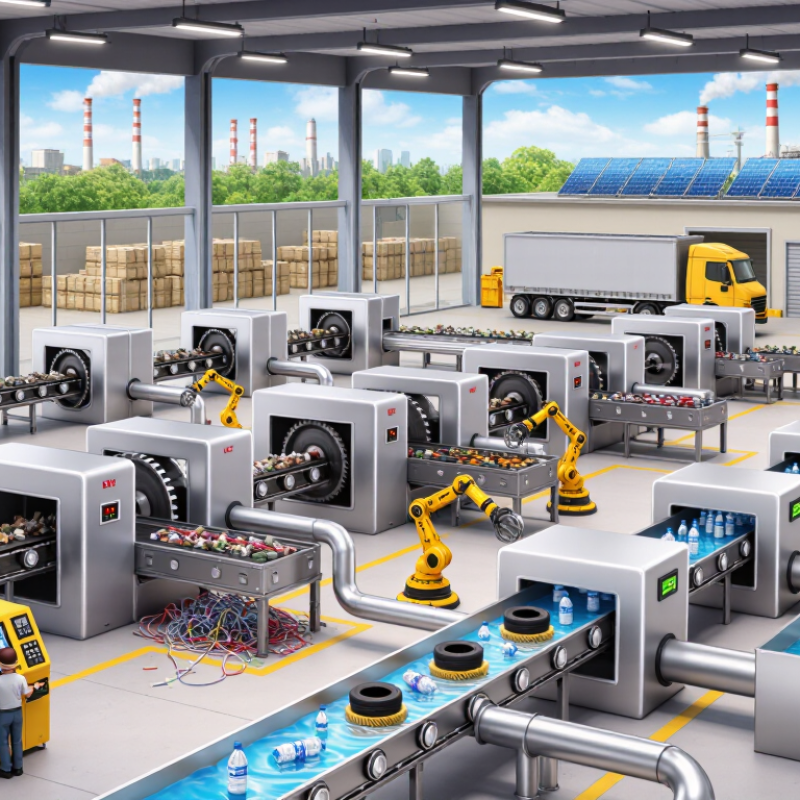
China Top 10 Recycling Machine Manufacturers for Global Buyers

What Defines a Leading Recycling Machine Manufacturer in China

What Defines a Leading Recycling Machine Manufacturer in China

A leading recycling machine manufacturer proves performance beyond a polished brochure. The Global E-waste Monitor 2024 reported 62 million tonnes of electronic waste in 2022. Only 22.3% was formally collected and recycled. This gap increases pressure on equipment reliability, material recovery, and traceability. A serious manufacturer should explain its sorting accuracy, contamination tolerance, energy consumption, and tested output. Buyers should request trial results using their actual feedstock, not clean demonstration samples.

Engineering depth matters. A capable factory can adjust shredders, conveyors, separators, and washing systems for different materials. It should provide drawings, safety documentation, spare-parts plans, and remote troubleshooting. The OECD’s Global Plastics Outlook found that only 9% of plastic waste was recycled in 2019. That figure exposes a difficult reality: impressive capacity does not guarantee useful recycling results. Moisture, labels, dust, and mixed polymers can quickly reduce production quality.

Inspect the workshop carefully. Look for weld consistency, guarded moving parts, instrument calibration, and clear assembly records. Ask how throughput is measured. Ask what happens after installation. No supplier is perfect. Even strong manufacturers may underestimate maintenance needs or local operating conditions. Independent testing, transparent warranties, operator training, and documented after-sales support help reduce that risk. A dependable Chinese manufacturer earns trust through repeatable evidence, not promises.

China Top 10 Recycling Machine Manufacturers for Global Buyers

What Defines a Leading Recycling Machine Manufacturer in China?

Throughput capacity is a practical benchmark for comparing recycling machine suppliers. The ranges below reflect commonly published industrial specifications for major recycling equipment categories, while actual performance depends on material composition, moisture, contamination, configuration, and operating conditions. A leading manufacturer should combine suitable capacity with stable output quality, energy efficiency, automation, safety compliance, and reliable after-sales support.

Unit: metric tonnes per hour (t/h). Indicative industry benchmark ranges; verify final capacity through a material test and technical proposal.

How the Top 10 Chinese Manufacturers Were Selected

Selecting China’s top ten recycling machine manufacturers requires more than counting export volume or website rankings. We assessed each company through documented production experience, technical capability, and buyer feedback. Factory records, equipment catalogs, and project references were checked against consistent criteria. Evidence matters.

We examined machine types, processing capacity, energy use, safety systems, and material compatibility. Practical details were important, such as cutter maintenance access, conveyor alignment, and replacement-part availability. We also reviewed quality-control procedures, testing reports, and staff engineering experience. Manufacturers with clear specifications scored higher than those using vague performance claims. Site visits, video inspections, and independent communication helped verify production conditions where possible.

Commercial reliability also shaped the ranking. We considered response speed, installation guidance, training, warranty terms, and after-sales support. Export experience was reviewed through shipping records and customer references, not assumptions. Compliance documents were checked for relevance to the target market and equipment type. Some evaluations remained incomplete because public data was limited. That limitation deserves honesty. A polished website cannot replace long-term operating evidence. Therefore, the list reflects transparent scoring rather than absolute superiority, with attention to measurable results, realistic service capacity, and the buyer’s actual recycling application.

China’s Top 10 Recycling Machine Manufacturers for Global Buyers

China’s top 10 recycling machine manufacturers for global buyers reflect a broad industrial ecosystem. Their equipment commonly covers plastic washing, shredding, granulation, sorting, and metal recovery. A serious buyer should inspect more than catalog photographs. Factory visits can reveal weld quality, wiring discipline, spare-parts storage, and actual test material. These details matter. They often predict service performance better than polished sales language. Ask for production records, material specifications, energy data, and references from comparable plants. Independent inspection is worthwhile before shipment.

Experienced manufacturers usually adapt machines to local feedstock, climate, voltage, and labor conditions. A line designed for clean factory scrap may struggle with dusty post-consumer material. Request a filmed trial using your own sample. Measure output, moisture, contamination, noise, and power consumption. Confirm whether quoted capacity means hourly input or finished product. That difference can distort the investment plan. Safety guards, emergency stops, dust control, and accessible maintenance points should be checked against local requirements. Documentation should include drawings, manuals, recommended wear parts, and commissioning procedures.

Reliability is not guaranteed by a large export list. It grows through transparent testing and responsive technical support. Buyers should compare warranty terms, remote troubleshooting, installation training, and delivery milestones. Some suppliers may promise too much. That deserves careful questioning. A practical contract can link payments to inspection, trial results, and complete documentation. The best choice is not always the cheapest machine. It is the system that performs steadily with realistic inputs, measurable costs, and support that remains available after installation.

China Top 10 Recycling Machine Manufacturers for Global Buyers
Listing Primary Recycling Focus Common Feedstock Typical Throughput Typical Machine Configuration Automation Level Common Buyer Applications Export-Readiness Indicators Recommended Buyer Verification
01 Plastic Recycling
Washing, size reduction and pelletizing systems
PP, PE, HDPE, LDPE film, rigid plastic and post-industrial scrap 300–1,500 kg/h Shredder or crusher, friction washer, dewatering unit, hot washer and pelletizing line Automatic feeding and temperature control; manual quality inspection commonly retained Plastic recyclers, packaging waste processors and compound-material producers English documentation, container-load shipping support and customized electrical standards Request a feedstock test, energy-consumption data and finished-pellet samples
02 PET Bottle Recycling
Flake production and cleaning lines
PET bottles, preforms and selected polyester waste 500–3,000 kg/h Bale breaker, label remover, crusher, hot washer, flotation tank, dryer and sorting equipment PLC-based process control with automated temperature, water-flow and conveyor monitoring Fiber, sheet, strapping and recycled PET flake production Layout drawings, water-treatment options and installation guidance for overseas sites Confirm flake moisture, PVC separation, color sorting and final contamination levels
03 Tire Recycling
Rubber granule and crumb-rubber systems
Passenger-car tires, truck tires and selected rubber products 500–2,500 kg/h Pre-shredder, secondary granulator, magnetic separator, fiber separator and screening units Automatic conveyor sequencing with operator-controlled safety and maintenance functions Rubber flooring, playground surfaces, asphalt modifiers and molded rubber products Dust-control options, modular delivery and overseas commissioning support Check output particle-size distribution, steel recovery rate and dust-emission controls
04 E-Waste Recycling
Printed circuit board and cable separation
Waste cables, circuit boards, small electrical appliances and electronic scrap 100–1,000 kg/h Pre-shredder, hammer mill, magnetic separator, eddy-current separator and air separation Integrated control cabinet with adjustable separation parameters Metal recovery from cables, electronic scrap and mixed non-ferrous materials Dust collection, enclosed transfer points and documentation for environmental compliance Verify recovery rates for copper, aluminum and ferrous metals using representative feedstock
05 Cable Recycling
Granulation and metal-plastic separation
Copper cable, aluminum cable, communication wire and mixed insulated wire 100–800 kg/h Cable stripper, granulator, air separator, vibrating screen and dust collector Semi-automatic to automatic, depending on cable diameter and sorting requirements Scrap-metal dealers, wire processors and secondary copper producers Multiple voltage options, spare-wear-part packages and compact container-friendly layouts Test mixed cable samples and confirm copper purity, recovery percentage and blade life
06 Organic Waste
Composting and food-waste treatment equipment
Food waste, market waste, agricultural residues and biodegradable materials 1–20 tons/day Sorting station, crushing unit, dewatering equipment, fermenting vessel and screening system Automated temperature and moisture monitoring with scheduled turning or mixing Municipal waste treatment, food-processing facilities and agricultural operations Odor-control options, modular project design and site-specific process engineering Confirm local permitting, odor-control performance, residence time and final compost quality
07 Metal Recycling
Scrap processing and separation systems
Ferrous scrap, aluminum scrap, copper scrap and mixed light-metal waste 1–10 tons/h Metal shredder, hammer mill, magnetic separator, eddy-current separator and sorting conveyor PLC-controlled line operation with optional automated material sorting Scrap yards, foundries, metal processors and material recovery facilities Wear-resistant components, safety guarding and selectable motor configurations Review motor power, throughput assumptions, wear-part cost and noise-control measures
08 Textile Recycling
Fiber opening and fabric-waste processing
Cotton waste, polyester textiles, denim, nonwoven waste and garment offcuts 100–1,000 kg/h Pre-cutter, tearing machine, fiber opener, dust filter and baling or packing equipment Semi-automatic feeding with adjustable opening and fiber-cleaning parameters Recycled fiber, insulation, wiping materials and nonwoven production Customized line arrangement, dust-filtration options and remote technical support Evaluate fiber length, dust content, production loss and compatibility with target textiles
09 Paper Recycling
Pulping, screening and dewatering equipment
Waste paper, cardboard, office paper and mixed paper packaging 1–50 tons/day Hydrapulper, coarse screen, fine screen, cleaner, thickener and dewatering system PLC monitoring for pulping consistency, stock flow and screening operations Recycled paper mills, carton plants and packaging-material producers Water-recycling options, process-layout engineering and replacement-screen availability Confirm pulp yield, reject percentage, water consumption and target paper-grade compatibility
10 Mixed Waste Sorting
Mechanical sorting and material recovery systems
Municipal solid waste, commercial waste, packaging waste and construction-related recyclables 5–100 tons/h Bag opener, trommel screen, ballistic separator, magnetic separator and sorting cabins Mechanical sorting with optional optical identification and centralized line control Material recovery facilities, municipal contractors and large waste-management projects Turnkey layout planning, safety systems and phased capacity expansion options Use a site-specific waste audit to validate recovery rate, labor demand and residual-waste volume

Key Differences in Technology, Capacity, and Product Range

Global buyers comparing the top ten recycling machine manufacturers should examine technology before headline capacity.

The OECD reports that only 9% of global plastic waste was recycled in 2019. This gap increases demand for washing lines, shredders, pelletizers, and optical sorting systems.

Advanced lines combine near-infrared sensors, automatic density separation, and closed-loop water treatment. Basic systems may rely on manual sorting and single-stage filtration. They cost less, but contamination can reduce pellet quality and machine uptime.

Capacity claims require careful testing. A line advertised at 1,000 kilograms per hour may achieve less with wet, mixed, or heavily contaminated feedstock.

The Global E-waste Monitor 2024 recorded 62 million tonnes of electronic waste in 2022, while only 22.3% was formally recycled.

This supports demand for specialized cable granulators, dismantling equipment, and dust-control systems. Product range matters here. A supplier offering only plastic shredders cannot address metal recovery or complex electronic components.

Machine selection should match local waste composition, labor skills, energy prices, and maintenance access. Ask for verified throughput data, power consumption, screen-life records, and sample output tests.

Capacity figures are not perfectly comparable. That weakness matters. The World Bank’s What a Waste 2.0 projects global municipal waste could reach 3.4 billion tonnes annually by 2050.

Buyers should therefore value modular upgrades, spare-part availability, and operator training, not only large initial output. Some purchasing decisions still overvalue speed. Reliable separation and consistent product quality usually matter more.

How Global Buyers Can Evaluate Suppliers and Place Orders

When comparing China’s top recycling machine manufacturers, global buyers should inspect more than catalog prices. Ask for factory registration, export history, production capacity, and recent project references. A reliable supplier should provide machine drawings, material specifications, throughput data, energy consumption, and safety documentation. Request evidence, not promises. Video calls can reveal workshop conditions, but an independent factory audit offers stronger confirmation.

Define your feedstock clearly, including moisture, contamination, particle size, and daily volume. These details affect shredders, washing lines, separators, and pelletizers. Request a sample test using your own material. Review the output quality, electricity use, noise level, and maintenance time. A written test report should include operating conditions and measured results. Small details matter. I have seen buyers compare only hourly capacity, then discover that actual output dropped sharply with wet or mixed materials.

Before ordering, confirm the final configuration, spare parts list, installation scope, training, warranty, and response times. Use a contract with acceptance criteria linked to measurable performance. Clarify inspection rights before shipment and agree on payment milestones. Check import duties, electrical standards, safety requirements, and environmental rules in the destination country. Avoid vague terms such as “high efficiency.” Require numbers. A pre-shipment inspection is useful, though it cannot replace commissioning at your facility. Allow time for adjustments, because even a well-designed line may need changes after installation.

Scroll to Top