| Selection | Service fluid and compatibility | Confirm compatibility with the transported liquid, additives, temperature range, salinity, and any cleaning chemicals. Check the tube, cover, reinforcement, gaskets, and couplings as a complete assembly. | No swelling, softening, cracking, delamination, excessive permeation, or chemical attack is permitted during the intended service. | Before purchase and whenever the cargo or operating chemistry changes; retain compatibility documentation. |
| Internal diameter and flow capacity | Select the bore to meet the required transfer rate without creating excessive pressure loss or fluid velocity. The complete system should be assessed, including reducers, valves, and swivel joints. | Calculated flow, pressure drop, and pump duty remain within the system design limits. | Verify during engineering design and after any change to the transfer system. |
| Working pressure and surge pressure | Choose a hose with a rated working pressure above the maximum steady pressure and anticipated transient pressure. Consider pump start-up, valve closure, water hammer, and pressure trapped by thermal expansion. | Maximum operating and transient pressures do not exceed the assembly rating or the lowest-rated connected component. | Confirm at design review and whenever operating pressure or equipment changes. |
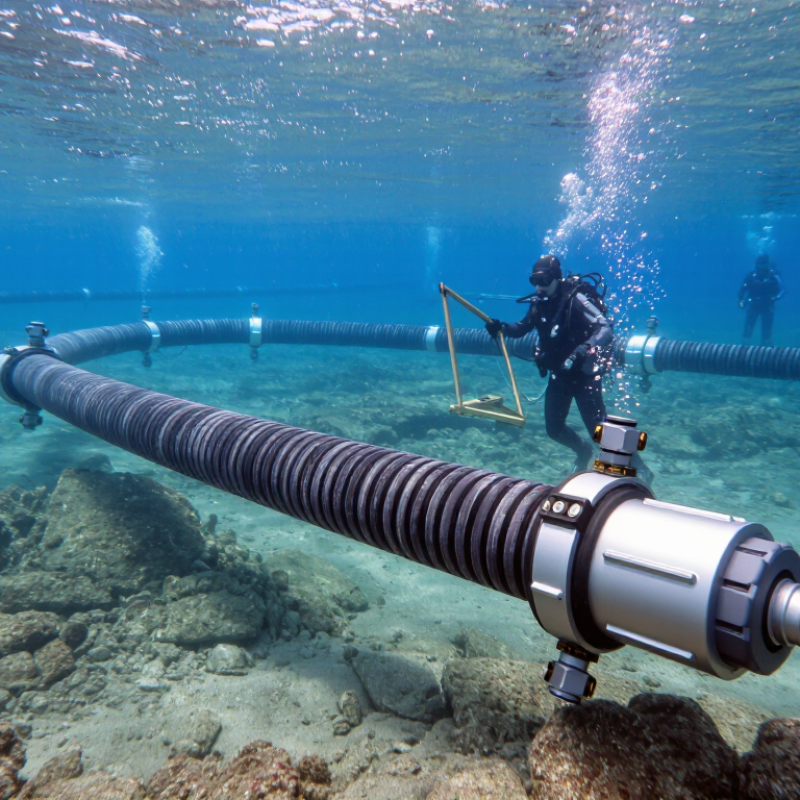
| External pressure and water depth | For submerged service, evaluate hydrostatic pressure at the planned depth, collapse resistance, buoyancy, and any pressure differential during draining or flooding. | The hose remains stable and functional at the maximum depth and under the most severe internal-to-external pressure differential. | Verify by design calculation and supplier technical data before installation. |
| Bend radius and flexibility | Determine the minimum static and dynamic bend radius, then allow for vessel movement, current, wave action, seabed contact, and installation tolerances. | The hose is never kinked, sharply folded, or operated below its specified minimum bend radius. | Check during routing design, installation, and every positional inspection. |
| Temperature and environmental exposure | Match the hose to the minimum and maximum fluid temperature and external conditions, including sunlight, seawater, abrasion, marine growth, and suspended particles. | The selected construction remains suitable throughout the full operating and storage temperature range. | Record design temperatures and review them before seasonal or process changes. |
| End connections and traceability | Confirm flange, threaded, quick-connect, or specialist coupling dimensions, gasket material, bolt requirements, electrical continuity needs, and hose identification markings. | Connections fit without forced alignment; the hose has a unique identification number and documented test history. | Check before delivery, installation, and each major inspection. |
| Installation | Pre-installation visual examination | Inspect the full length for cuts, bulges, exposed reinforcement, flattened sections, cover separation, damaged couplings, corrosion, contamination, and missing markings. | Reject or quarantine any hose with structural damage, uncertain history, visible leakage, or illegible identification. | Before every installation; document photographs and inspection results. |
| Handling and lifting | Use lifting points, soft slings, rollers, and adequate support. Do not drag the hose over sharp edges, pull it by the coupling, or lift it with unapproved hooks. | No crushing, twisting, impact damage, or coupling distortion occurs during handling. | Continuous supervision during transport and deployment. |
| Routing and support | Provide controlled support at bends and connection points. Protect against abrasion, sharp seabed objects, excessive span length, and contact with hot or moving equipment. | The hose follows the approved route without unsupported weight, chafing, kinks, or excessive movement. | Inspect immediately after deployment and after relocation or severe weather. |
| Connection and alignment | Align mating connections naturally. Install the correct gasket and tighten fasteners using the approved sequence and torque. Do not use the hose to correct pipe misalignment. | No twisting or side load is transferred to the hose; all fasteners and seals are properly installed. | Record connection checks before pressure testing. |
| Pressure and leak testing | Test the completed assembly using a written, approved procedure. Use a calibrated gauge, exclude personnel from hazardous areas, and increase pressure gradually. | No visible leakage, abnormal expansion, pressure loss, or movement occurs during the specified test. The test pressure and duration must follow the governing design or inspection requirement. | Before commissioning, after major repair, and at the interval required by the applicable procedure. |
| Operation and Maintenance | Pre-transfer inspection | Check the cover, couplings, supports, valves, bonding or continuity provisions, protective devices, and surrounding equipment before starting transfer. | No visible defect, unsecured support, unexpected movement, or evidence of leakage is present. | Before every transfer operation. |
| Operational monitoring | Monitor pressure, flow, temperature, hose movement, and connection areas. Avoid sudden valve closure and keep within the approved operating envelope. | Readings remain within design limits and no abnormal vibration, noise, odor, or seepage is observed. | Continuously during transfer; retain operating logs. |
| Routine visual inspection | Inspect for abrasion, cuts, blisters, bulges, flattening, cover hardening, exposed reinforcement, corrosion at couplings, and damaged protective sleeves. | Remove from service if structural reinforcement is exposed, a bulge develops, leakage is detected, or damage affects the pressure boundary. | At a risk-based interval, and at least after unusual loading, impact, or severe weather. |
| Cleaning and storage | Flush or clean using a compatible method, drain trapped liquid, cap the ends, and store away from direct sunlight, ozone-producing equipment, heat, chemicals, sharp edges, and standing water. | The hose is dry or preserved as specified, capped, supported without tight bends, and protected from contamination. | After use and throughout storage; record storage date and condition. |
| Periodic integrity assessment | Combine visual examination with dimensional checks, coupling inspection, and any approved non-destructive or pressure test appropriate to the hose construction and service. | The assessment confirms continued suitability, or the hose is repaired, re-tested, downgraded, or retired. | Set by risk assessment, service severity, inspection history, and applicable regulations; never rely on age alone. |
| Retirement and incident control | Quarantine the hose after leakage, overpressure, excessive bending, impact, fire, chemical exposure, or unexplained deformation. Investigate before returning it to service. | Return to service only after documented assessment and testing by qualified personnel; replace when repairability or history is uncertain. | Immediately after an incident; update the hose register and maintenance history. |